
A practical journey into IoT-driven optimization for flexible manufacturing environments
.jpg)
Nikhil C V
Head of Customer Success, Wipro Linecraft AI
With 18 years of experience spanning Industrial Automation, Robotics, Industry 4.0, and Supply Chain Technology, Nikhil leads Customer Success at Wipro Linecraft AI.
Starting as a controls programmer, he has delivered 50+ projects across India, USA, Canada, and Mexico, with deep expertise in design, installation, and program management.
As co-founder of a supply chain tech startup, Nikhil led development of an award-winning product recognized by the Indian Institute of Material Management and a Fortune 500 company. This technical and entrepreneurial background uniquely positions him to drive customer success at Linecraft AI.
The Linecraft product was deployed on a complex Battery Assembly line at a leading North American automotive manufacturer. The line featured manual, semi-automatic, and robotic stations with Automated Guided Vehicles (AGVs), presenting unique throughput challenges due to its flexibility and multiple part variants.
Previous productivity improvement efforts plateaued due to limited visibility into true bottlenecks and flow disruptions
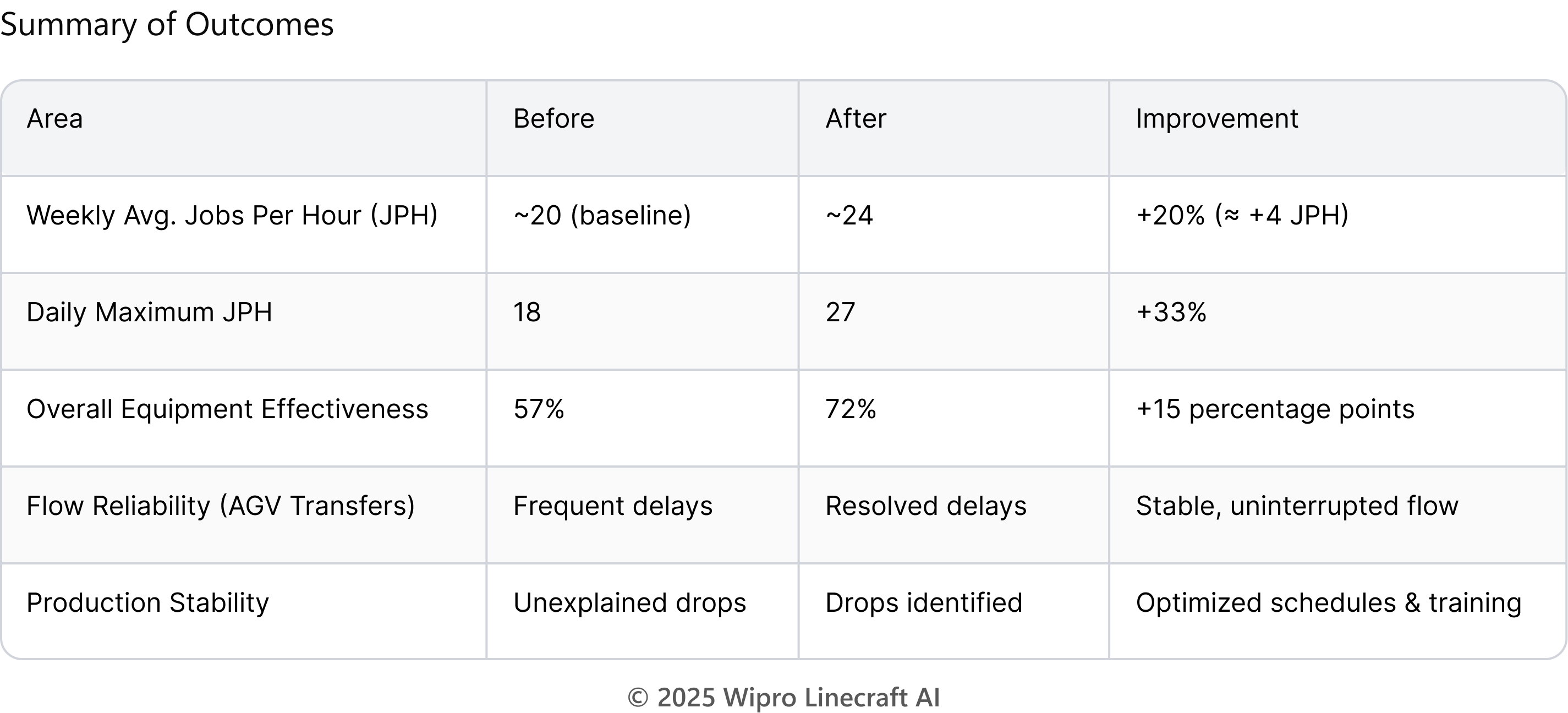
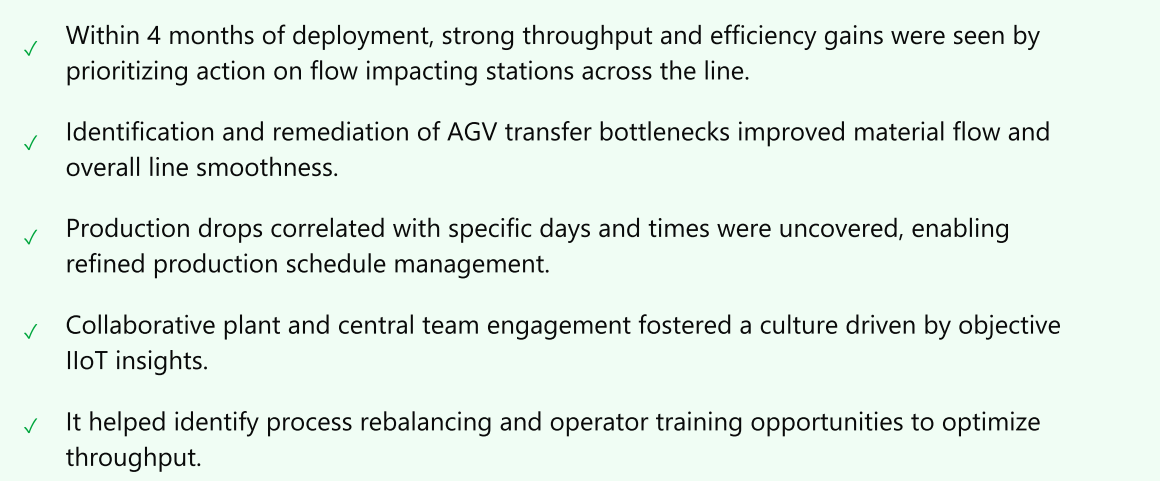
Key outcomes within the first 4 months of deployment include:
Summary of Outcomes
Strategic Value
This data-driven approach fostered collaboration between plant and central teams, validated and improved existing Business Intelligence (BI) configurations, and established a scalable, continuous improvement model applicable to other complex manufacturing lines. It also brought to light the lag in effectiveness of conventional systems that rely on the line integrators programming to correctly report the data being captured especially for ramp up line, where their focus is proving their equipment and might not report the correct data initially.
The Battery Assembly Line is part of a leading automotive manufacturing plant in North America. It consists of about60 assembly stations combining manual assembly, semi-automatic processes, and robotic automation. AGVs support the line by transporting battery assemblies, enabling process flexibility via multiple paths and sequences to accommodate various part variants and production mix.
While this flexibility and advanced automation allow scalable production, it also introduces increased complexity in identifying which issues truly impact throughput. Prior to deploying the Linecraft product, the team faced these challenges firsthand. Multiple, often unrelated issues were addressed without achieving commensurate throughput gains at the line end. Traditional systems and manual analysis could not clearly distinguish flow-related bottlenecks from station-level inefficiencies, leading to scattered improvement efforts lacking measurable results.
The Linecraft product was implemented to bring data-driven clarity by providing actionable insights focused on throughput-impacting bottlenecks using advanced line-wide flow analysis
The manufacturing line was facing significant throughput challenges driven by a combination of operational inefficiencies. Cycle time variations and over-cycling at multiple stations caused frequent slowdowns, while the existing bottleneck detection tools—focused narrowly on station-level analysis—failed to uncover the broader flow-related issues affecting end-to-end performance.
As a result, improvement efforts were often misdirected toward non-critical stations, yielding only marginal benefits. Hidden constraints, such as AGV transfer delays, further compounded the inefficiencies. In addition, variability across days and shifts created planning difficulties and made it harder to maintain consistent output.
Impact Statement:
Together, these issues create a fragmented view of performance, where localized fixes fail to resolve systemic bottlenecks. The inability to see and manage line-wide flow leads to persistent inefficiencies, reduced productivity, and higher operational costs. Moreover, variability in performance erodes predictability, complicating planning and limiting the organization’s ability to meet demand reliably.
The Linecraft product leverages industrial IoT technology to capture detailed operational data from across the Battery Assembly line. Here is a simplified version of the architecture and data flow:
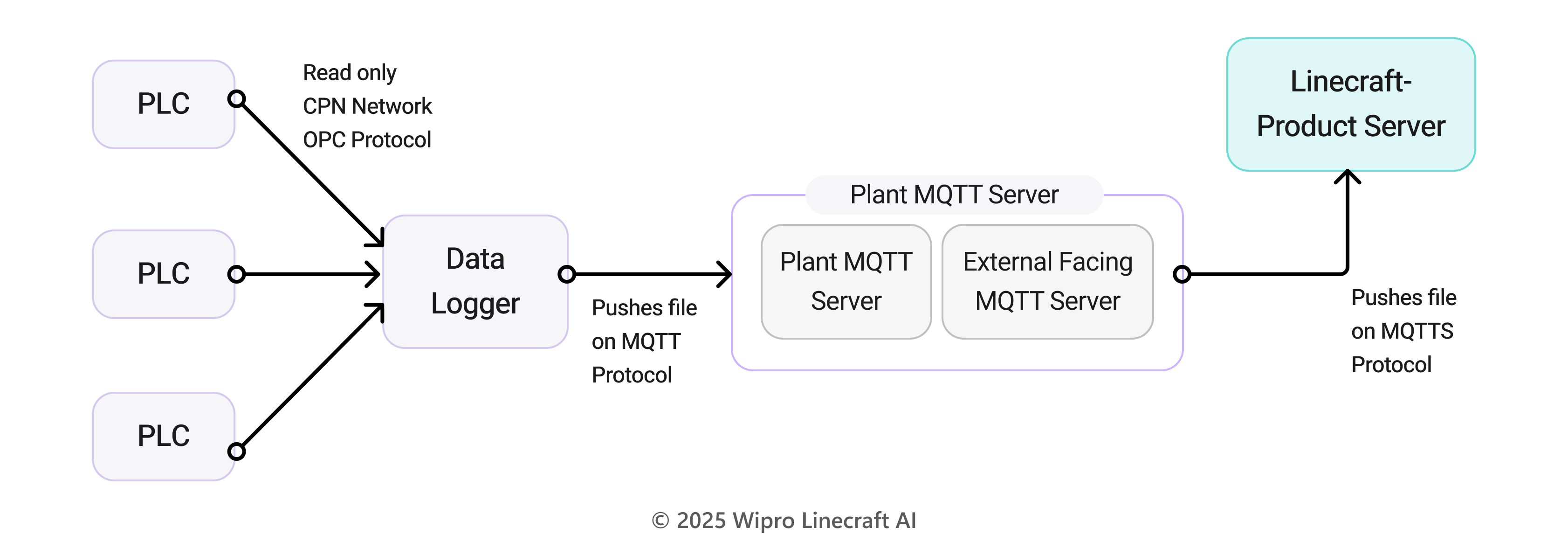
Edge devices deployed on the line collect sensor-actuator level data from controllers to build a model of the stations and line operations within the product ecosystem without requiring any logic implementations on the machines and down times related to it which is very typical with other IOT / BI solutions.
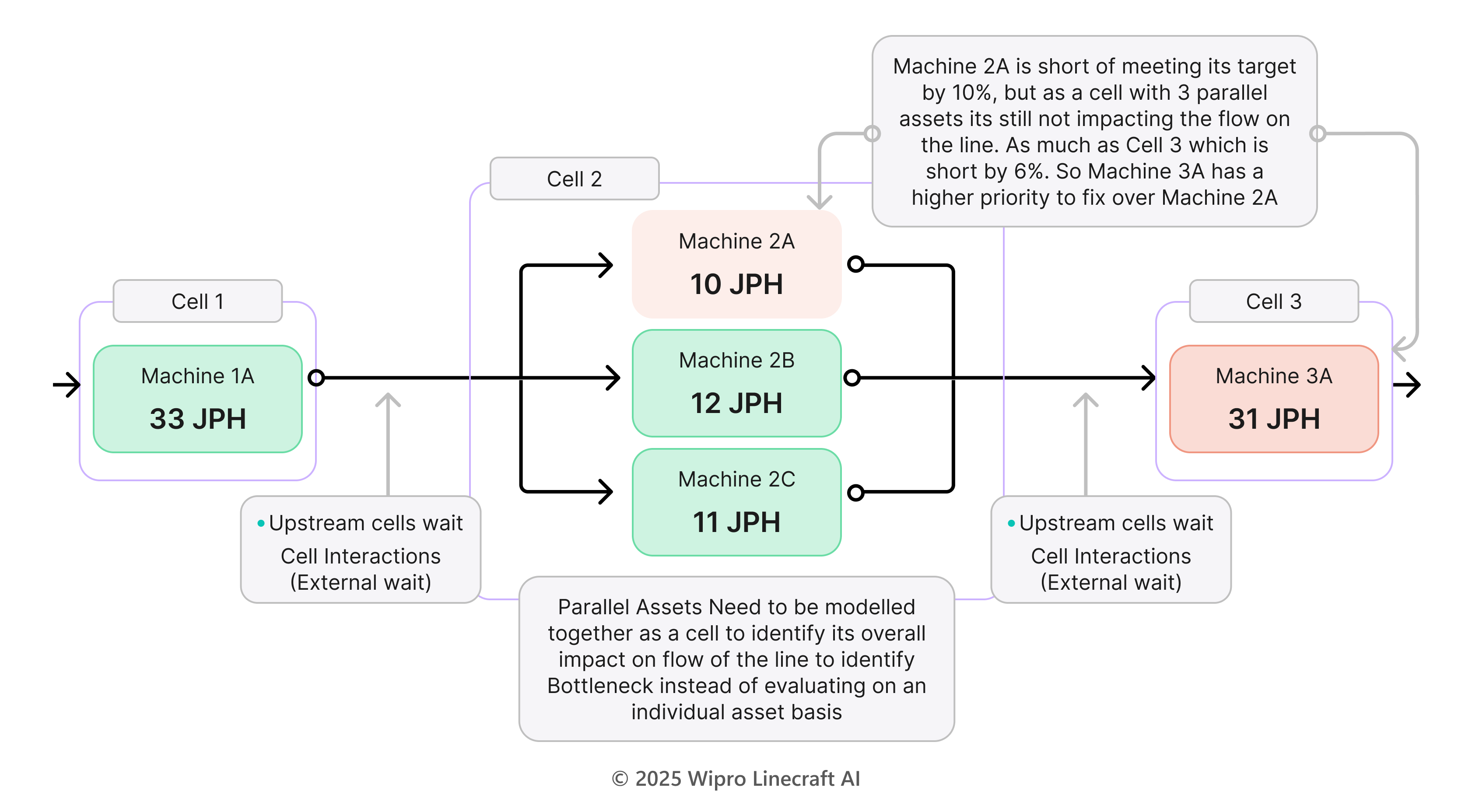
This digital model enables deep analysis of part flow dynamics and identification of throughput-impacting factors beyond simple station-level metrics. The images below explain the difference between the station based evaluation versus the flow based evaluation which is the additional capability in the Linecraft product.

Line flow analysis evaluates the flow of parts on the line to identify bottlenecks that are dynamic in nature occurring due to operational changes and might not reflect in the asset-based evaluation
A few examples of these -
The analytics platform highlights flow-related bottlenecks by aggregating and correlating data across stations and transfer points, including AGV operations, providing prioritized actionable insights.
Visualization dashboards provide shift-wise, station-wise, and time-based operational views to support continuous improvement.
Linecraft deployment enabled data collection and analytics consumption. The data and impact presented here focus on the initial 4 months post deployment to understand the immediate improvement seen.
Multiple stations, spanning both manual and automatic operations, were identified as bottlenecks. These were addressed through process optimization, operator training, and automation tuning.
Weekly collaborative sessions with plant and central teams reviewed bottleneck reports and defined corrective actions.
Insights from the Linecraft product validated and helped correct BI system bottleneck configurations, improving future detection accuracy.
AGV transfer delays and production drops at specific days and times were identified, informing operational changes and production schedule optimization.
Unlike traditional station-level metrics, the Linecraft product’s bottleneck feature analyzes flow at the edge of each process on the line, enabling identification of priority stations impacting overall throughput independent of their station metrics alone.
For example, certain stations previously ranked low by customer’s existing BI system were flagged as critical bottlenecks impacting flow by the Linecraft product’s advanced analysis (See image for comparative examples).
.png)
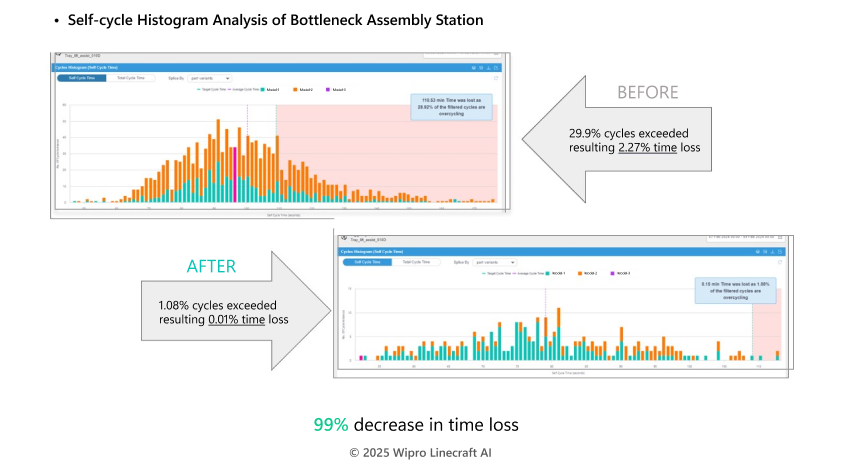
The image above shows cycle time spread for one of the top bottleneck assembly stations with different colors representing cycle time for different part variants.
The difference between the 2 images shows the before and after improvement in the stations efficiency once it was identified as bottleneck in Linecraft product and worked on for improvement.
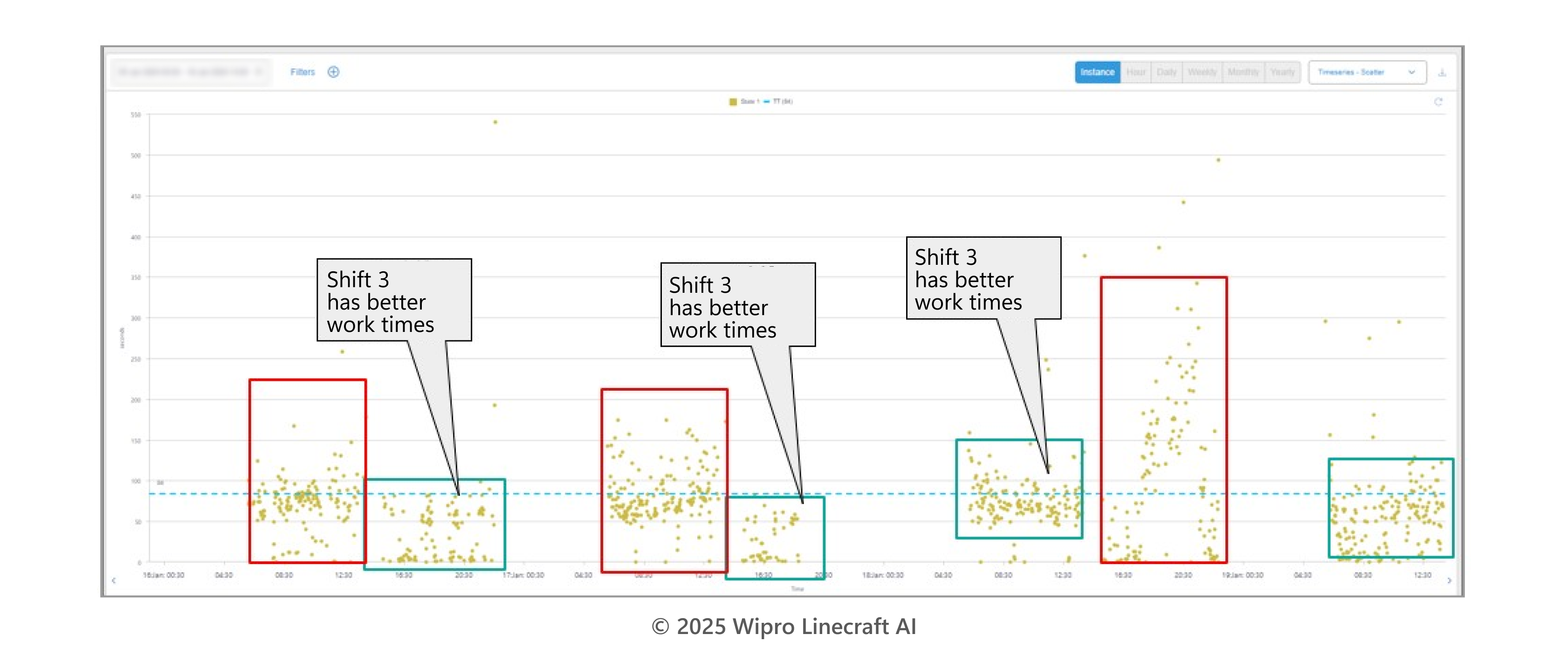
The image above shows a pattern with the cycle time variation on the assembly station repeating in certain shifts. This helped identify training opportunities for operator in one shift to match the process of the operator in the other shift to improve efficiency.
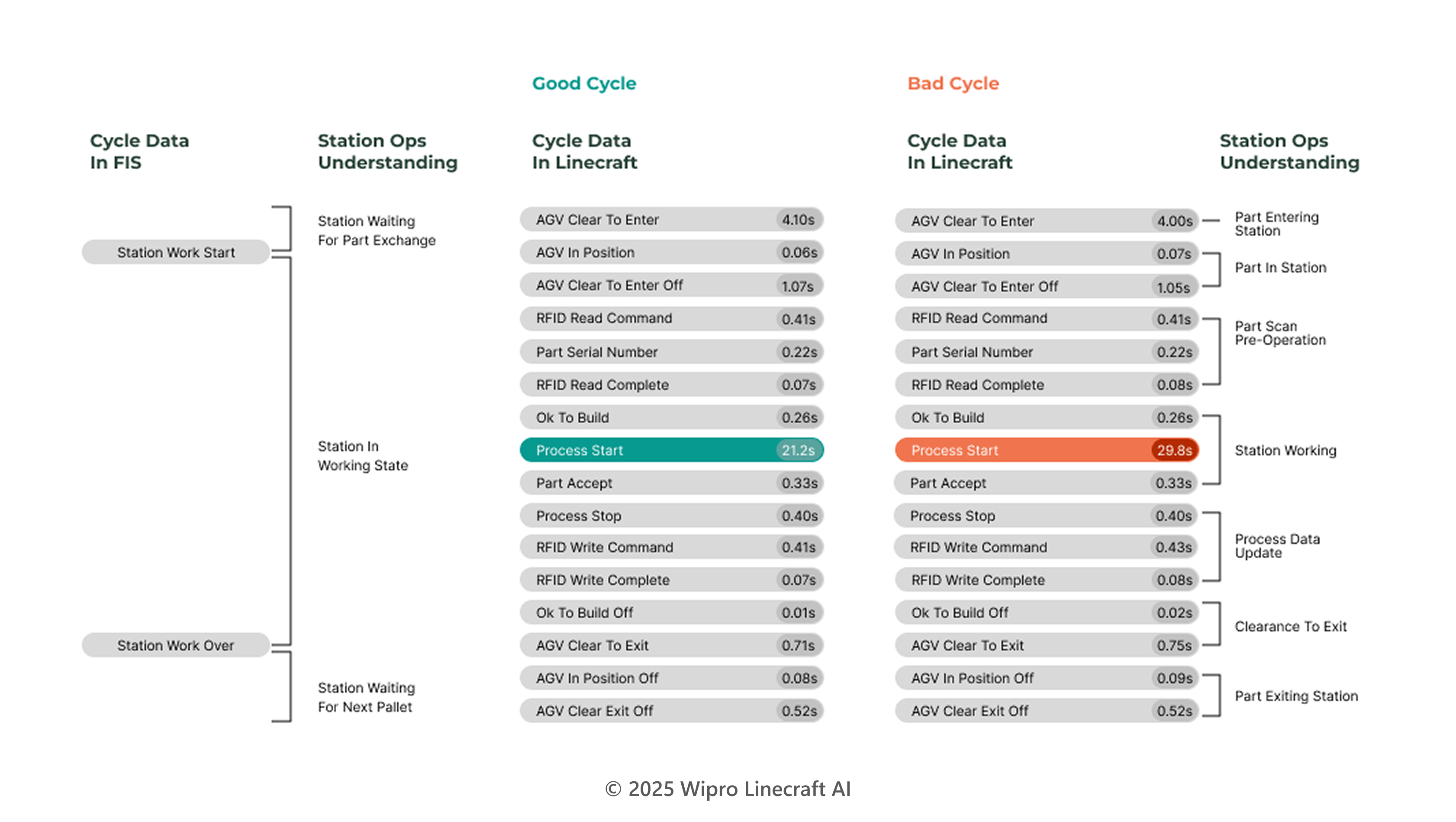
The image above explains the difference between level of granularity at which data can be analyzed in BI system versus available in the Linecraft IOT product, which helps provide the actionable insight to improve efficiency on stations as seen in the previous examples.
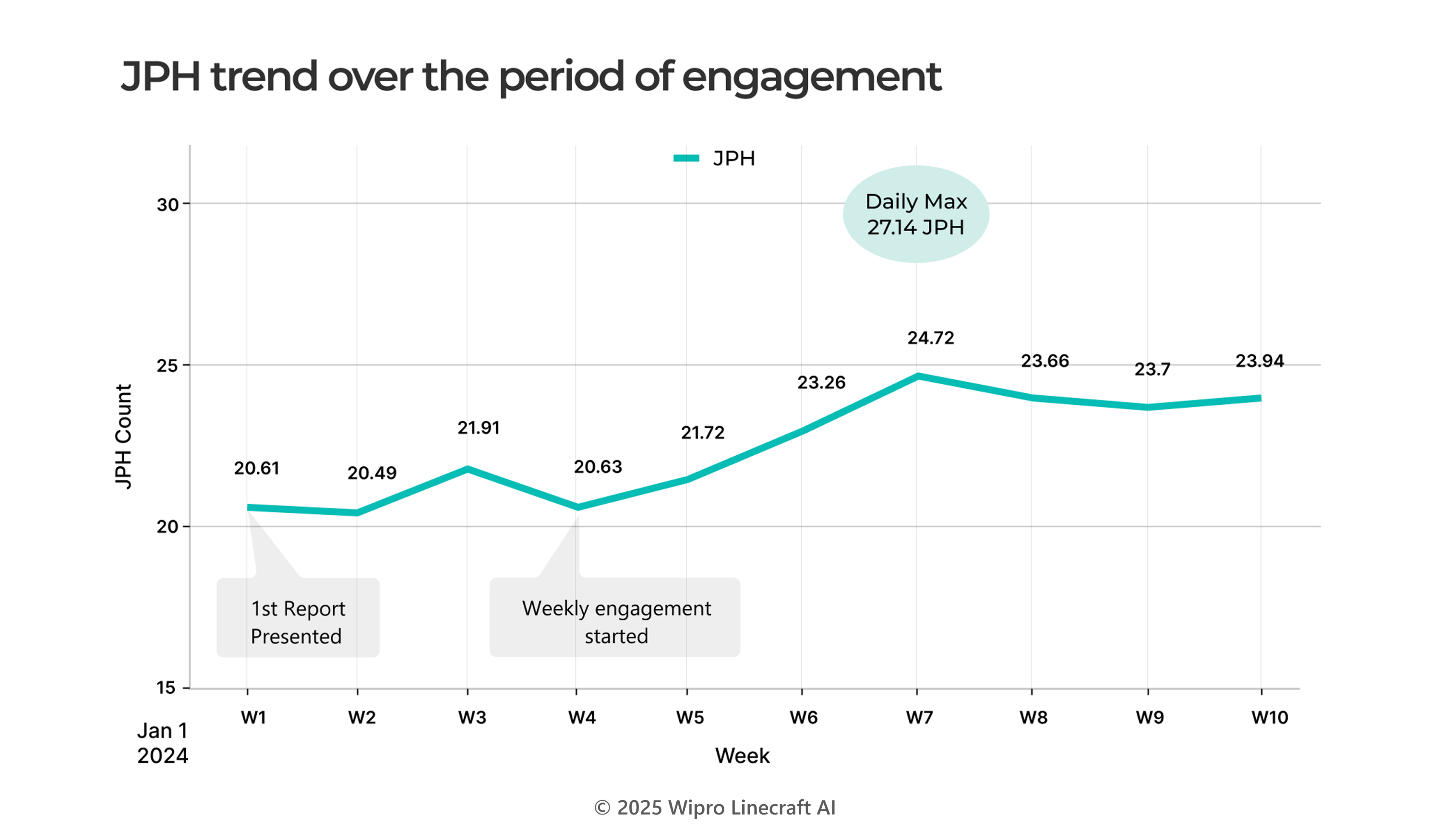
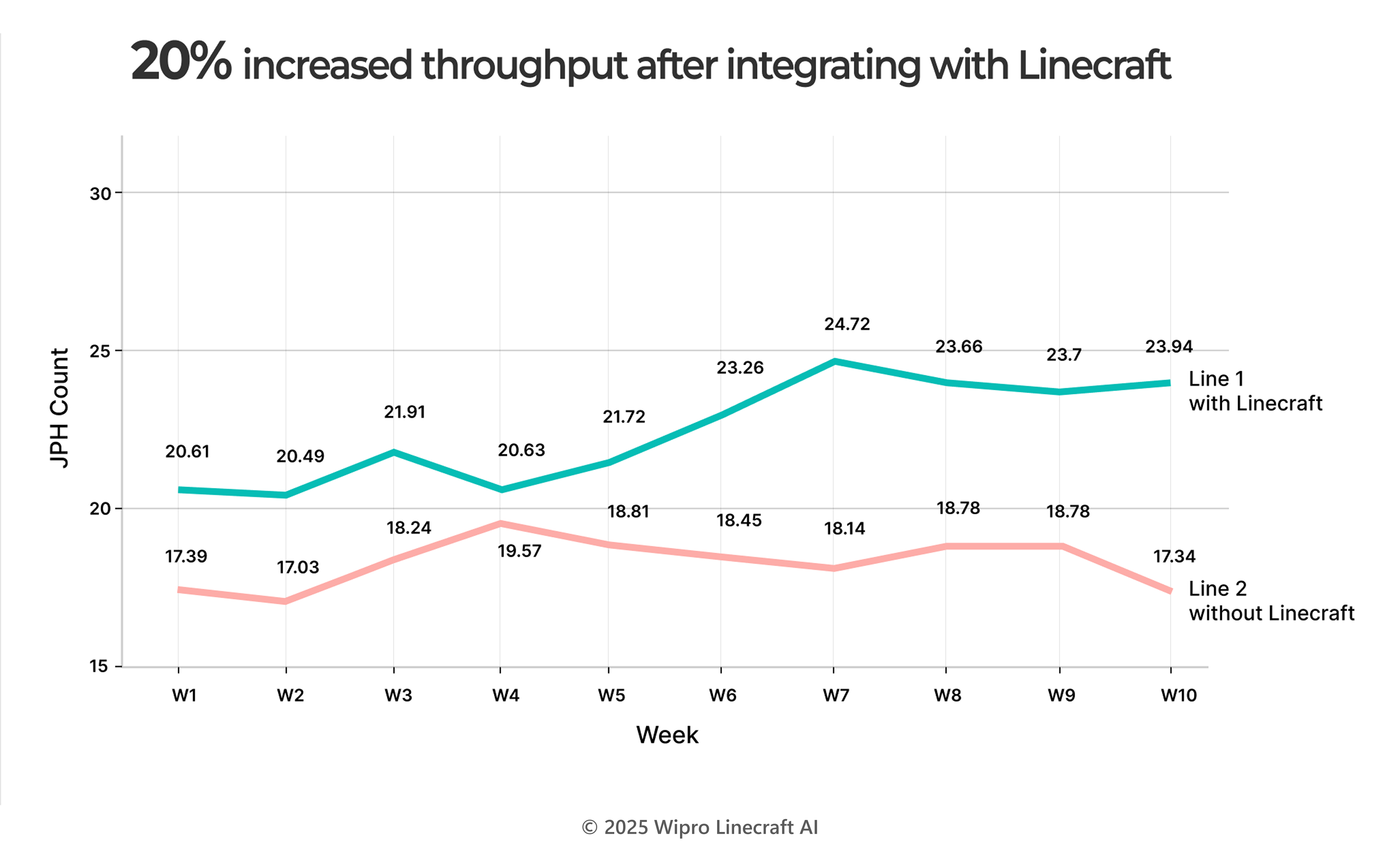
The production trend graph above shows comparison with a downstream line clearlydemonstrating the impact of the IIOT data driven approach on this line.
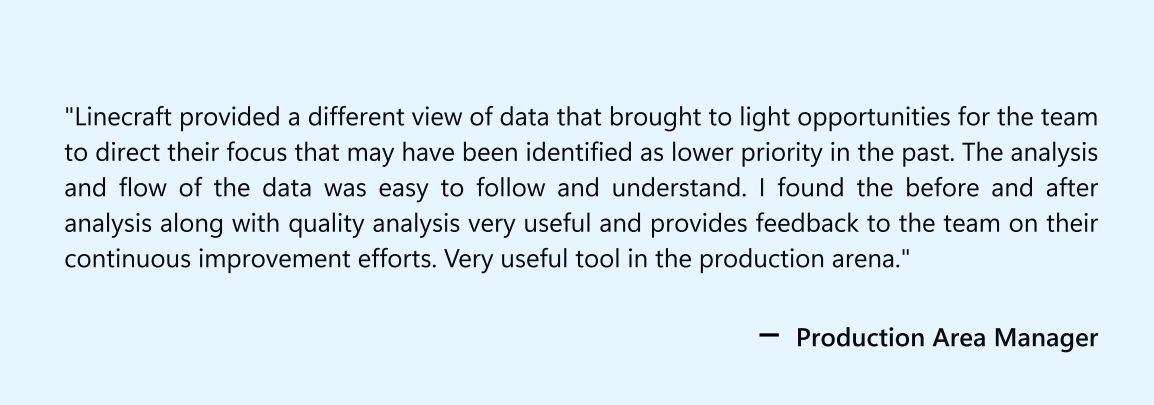
Initial skepticism regarding new bottleneck rankings compared to legacy BI system data required side-by-side data validation, which convinced stakeholders of the solution’s value.
Sustained collaboration between plant and central teams was vital for continuous momentum.
Rapid translation of data insights into operational actions was key to maximizing improvement impact.
The initial 4-month deployment of the Linecraft product successfully improved throughput and OEE on the Battery Assembly line by delivering clear, real-time insights into bottlenecks affecting flow and throughput.
With ongoing collaborative review and an expanding data-driven culture, the approach is positioned for sustained continuous improvement to accelerate ramp-up efficiency and capacity attainment. This approach has been so far successfully adopted on 10 different lines with this customer across North America and Europe to help improve productivity. The impact was especially higher with reducing ramp up timeline for new, retool or lines being relocated.
This clearly demonstrates effective usage of data collected from the line to analyze and improve the throughput efficiency of the line.
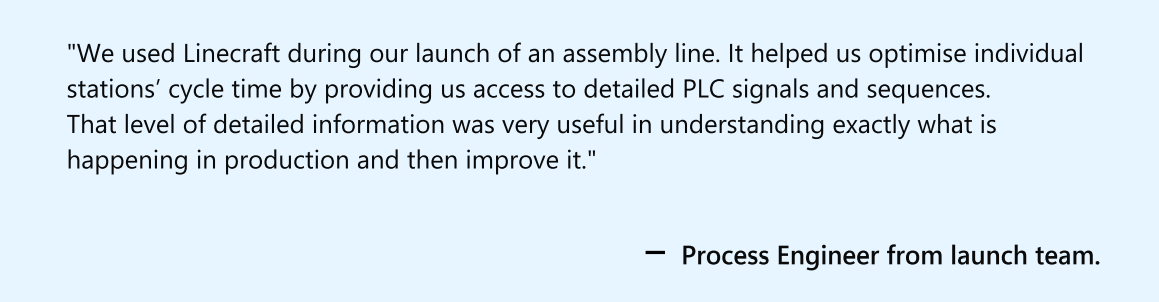
Customer Testimonial from another Assembly line in Europe.
.png)


