Data Collection IIoT Core
Sub-second polling rates (up to 1,000 Hz) directly from PLCs, CNCs, and robotics. Connects non-intrusively to Siemens, Rockwell, Beckhoff, Omron, and legacy controllers with zero ladder logic changes.
Linecraft AI connects and contextualizes shop-floor data to uncover downtime, overcycles, micro-stoppages, bottlenecks and performance losses across the production flow—then drills down to machine-level root causes and makes insights accessible through manufacturing AI.
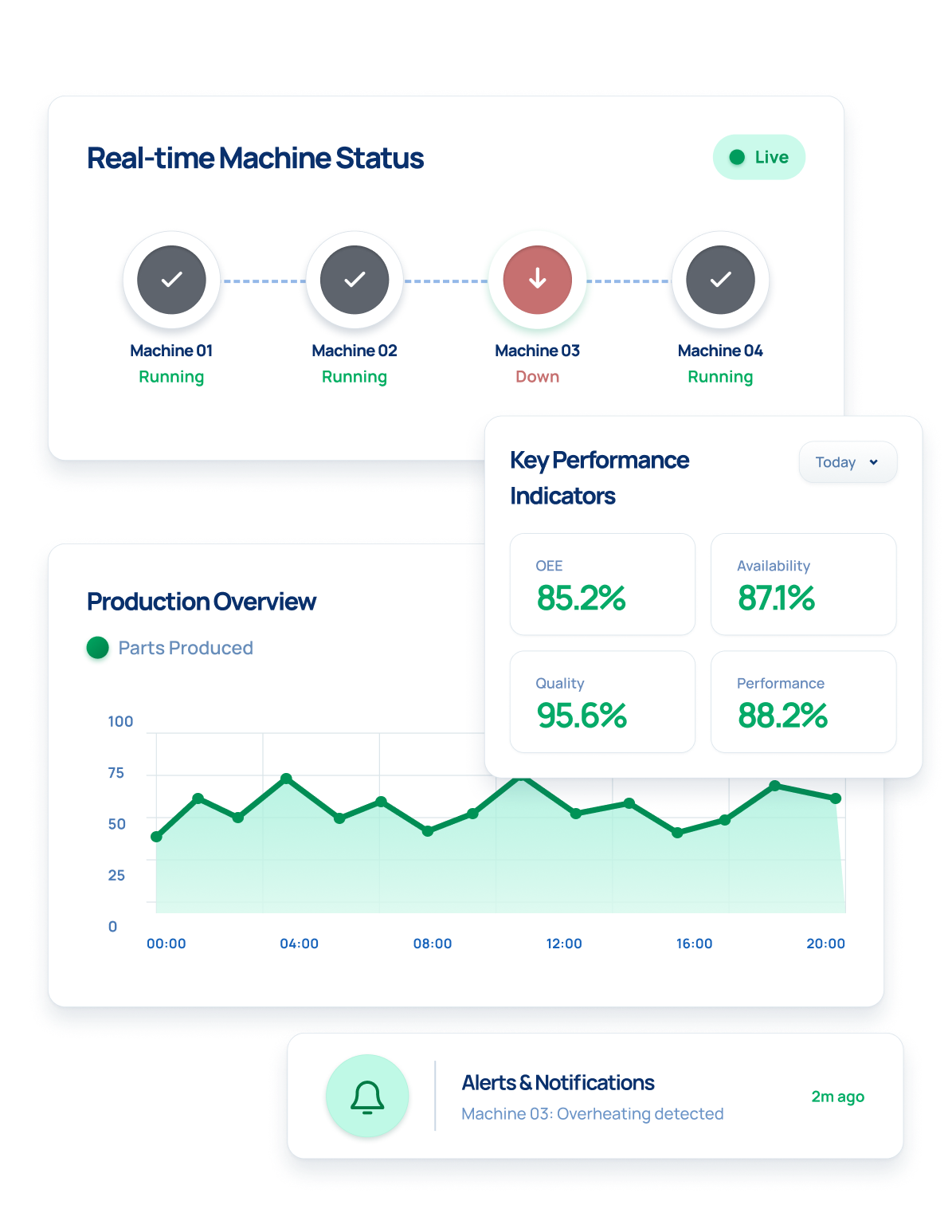
See whether production is meeting plan, where flow is being interrupted and which assets are affecting throughput. Analyze downtime, overcycles, short stops, blocked and starved conditions, cycle-time variation, changeovers and quality losses—all within the context of the complete production line.
Track output, target versus actual, shift performance, OEE, availability, cycle time and throughput.
Identify bottlenecks, blocked and starved conditions, WIP imbalance and upstream/downstream dependencies.
Investigate downtime, overcycles, micro-stoppages, faults, changeovers, speed losses and quality losses.
Analyze machine states, critical assets, cycle-time deviation, recurring faults and operating parameters.
Use natural language to analyze trends, compare shifts, investigate root causes and generate operational reports.
Measured throughput gains and downtime reduction across automotive assembly, EV battery, powertrain machining, and tyre manufacturing lines — with zero machine modifications.
"Linecraft has proven to be a valuable digital companion in our journey toward faster line commissioning, data-driven decision-making and more predictable production."
Autonomous millisecond PLC fault attribution eliminates chronic sub-60s micro-halts, liberating 1,400+ annual machine hours.
Decouples starving vs. blocking states to eliminate dynamic bottlenecks and pace production lines to full design capacity.
"We swiftly achieved our target cycle time for the automatic stations with Linecraft AI."
Continuous line flow balancing eliminates silent inter-station buffer starvation across parallel workcells.
Exposes robotic clearance retracts and sub-second intra-cycle variance to balance parallel workcells.
"Before Linecraft, identifying cycle time losses required manually collecting PLC logs, robot counters and operator feedback."
PLCs record alarm codes. MES counts parts at shift end. BI dashboards average yesterday's numbers. But when an assembly line loses 18 parts per hour, engineering teams still spend hours piecing together spreadsheets across multiple systems just to pinpoint which station caused the delay. That is where capacity is lost.
Plugs non-intrusively into Siemens, Rockwell, Beckhoff, or legacy controllers over existing factory Ethernet. Zero code modifications, zero line downtime, zero machinery CapEx.
Machines don't run in silos. Backed by U.S. Patent 11,468,216, our math maps how stations interact through buffers and conveyors, instantly separating true bottlenecks from downstream starvation.
Shift supervisors and plant directors get live pacing dials, lost-minute Pareto rankings, and buffer health scores — designed for fast shopfloor action, not retrospective data analysis.
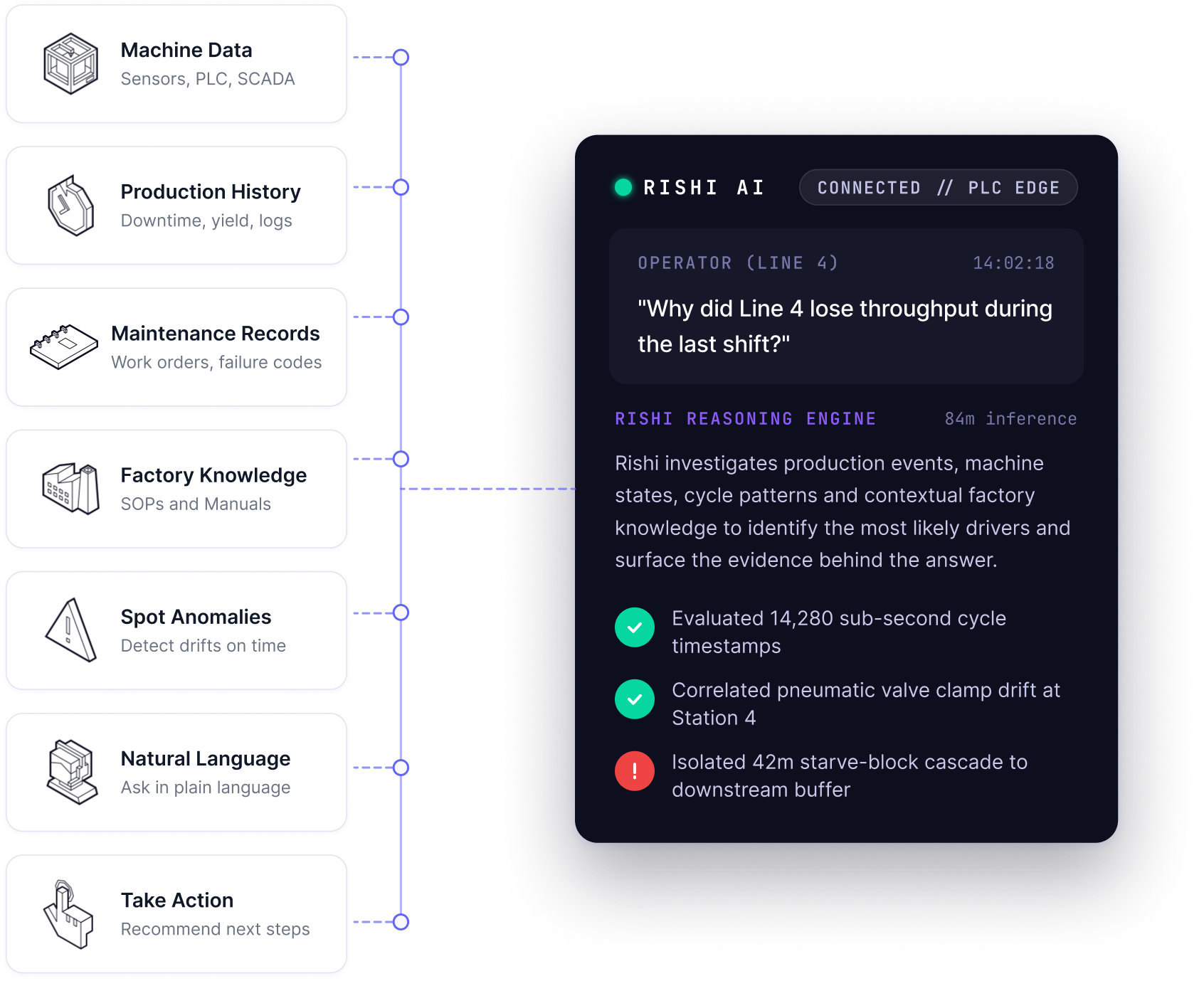
Ask questions like "Why did Cell 4 stop producing at 10:15 AM?" and get immediate, timestamped explanations backed directly by PLC telemetry — 100% grounded facts, never hallucinations.
A unified software pipeline backed by U.S. Patent 11,468,216: high-frequency PLC data collection, mathematical modeling of machine interactions, and verified root-cause diagnostics.
Most factories have data trapped across incompatible PLCs and legacy controllers. Linecraft's IIoT Core connects directly across Industrial Ethernet to stream high-frequency registers at sub-second speeds, automatically enriching and standardizing raw signals into high-fidelity operational events without touching existing ladder logic.
Sub-second polling rates (up to 1,000 Hz) directly from PLCs, CNCs, and robotics. Connects non-intrusively to Siemens, Rockwell, Beckhoff, Omron, and legacy controllers with zero ladder logic changes.
Cleanses sensor noise, aligns millisecond clock drifts, and transforms raw electrical and pneumatic telemetry into standardized operational events that reflect genuine line states.
Backed by U.S. Patent 11,468,216, our proprietary algorithms convert raw telemetry into discrete mathematical models of individual assets, then execute a line flow transformation model to calculate dynamic machine interactions across buffers and expose shifting bottlenecks.
Data processing algorithms convert raw sensor and PLC register transitions into discrete mathematical models of physical machines—profiling home-to-final state cycles, pneumatic settling, and micro-stoppages with millisecond precision.
Models physical machine interactions across conveyors, dynamic accumulators, and buffers. Accurately decouples line starvation and blocking from true machine faults to isolate transient bottlenecks.
Linecraft connects and presents multi-tier operational analytics for shift governance, while autonomous AI agents access the entire mathematical model to deliver 100% factual, engineer-verified answers with zero hallucination.
Linecraft Ikshana connects and visualizes continuous line flow, shift pacing vs. daily quota, transient bottleneck heatmaps, and financial loss translation—delivering clarity from operators to plant directors.
Rishi AI agents access the enriched mathematical model directly, performing multi-step diagnostic investigations linked to verified PLC timestamps. 100% grounded in factory truth with zero hallucination.
The 5-stage data processing pipeline that filters sensor noise, reconstructs physical machine states, and models line-level buffer interactions in real time — backed by U.S. Patent 11,468,216.
Polls native PLC registers, sensors, and actuators at sub-second frequencies (up to 1,000 Hz) across Industrial Ethernet with zero ladder logic changes.
Cleanses high-frequency telemetry, synchronizes millisecond timestamps, and contextualizes raw register tags into unified operational events.
Proprietary algorithms (US Patent 11,468,216) convert enriched data into discrete mathematical models of individual machines, cycle states, and toolpaths.
Models physical machine interactions across buffers, gantries, and serial/parallel cells. Decouples starvation and blocking to reveal transient bottlenecks.
Ikshana presents role-tailored dashboards, while Rishi AI agents access the entire mathematical model to deliver 100% truthful, verifiable root causes.
Ikshana calculates real-time machine interactions, buffer starvation, and dynamic bottlenecks across your entire line — showing CI teams exactly where to intervene for maximum throughput recovery.
Sub-second PLC capture for machine states, cycle times, and electrical/mechanical registers.
Decouples starvation and blocking from genuine breakdown to eliminate misdiagnosed downtime.
Builds a mathematical model using actual shopfloor data to expose shifting constraints and quantify throughput impact.
Traces workpieces through buffers to correlate station cycle deviations with quality outcomes.
Generic LLMs hallucinate when asked about manufacturing downtime. Rishi queries the mathematical model of your physical line, cross-referencing alarm timestamps, cycle deviations, and buffer states to give engineers 100% verified answers.
Identifies micro-halts, slow cycles, and shifting bottlenecks without manual log queries.
Ask "Which station starved Cell 3 during Shift A?" and receive timestamped evidence.
Traces cascade stoppages across upstream and downstream stations to identify the primary failure.
Direct operational feedback from line commissioning, cycle time optimization, and high-volume steady-state production.
Answers to technical and operational questions about downtime analysis, overcycle detection, line flow decoupling, and shopfloor integration.
Traditional downtime tracking relies on machine operators manually selecting fault reason codes on HMI touchscreens—a process that is prone to human error and misses sub-60-second micro-stops entirely. Linecraft connects directly to native PLC registers and controller states at sub-second intervals. It automatically timestamps every cycle interruption, emergency halt, and electrical fault, categorizing downtime directly from machine telemetry without requiring operator intervention.
An overcycle occurs when an automatic machine runs and passes quality checks, but takes longer than its target takt time (e.g., 52 seconds instead of 44 seconds). Because the asset never halts or trips an alarm, standard SCADA systems report 100% availability. On an interconnected production line, however, that 8-second delay causes upstream buffers to saturate (forcing upstream stations into Blocked states) and starves downstream bays. Linecraft flags recurring overcycles and isolates whether the root cause is pneumatic clamp drift, robot clearance paths, or tool degradation.
Bottlenecks in high-volume manufacturing are rarely fixed to one machine—they migrate across cells depending on part variant mixes, tool wear, and operator handoff pacing. Linecraft leverages patented mathematical line modeling (US Pat. 11,468,216) to continuously map buffer state changes, transfer gantries, and cycle pacing. It calculates the dynamic constraint percentage for every cell, quantifying precisely how many parts per hour (JPH) each station is costing the final line output.
Conventional OEE calculates availability, performance, and quality on machines in isolation. If Station 10 finishes its cycle but cannot discharge because the conveyor ahead is full, standard OEE penalizes Station 10 as "unplanned idle." Maintenance teams waste hundreds of hours troubleshooting mechanically sound equipment. Linecraft mathematically decouples blockage and starvation from genuine machine failures, directing engineering resources exclusively to the true pacing root cause.
Because Linecraft requires zero PLC ladder logic modifications and zero new sensors, lines connect in under 4 weeks. Most plants achieve verified cycle time attainment and throughput gains within the first 30 days of live telemetry—typically recovering 5% to 15% hidden capacity ($500K to $1.8M/line annual capacity value) without machinery CapEx.
No. Linecraft operates strictly via non-intrusive, read-only industrial communication protocols (OPC UA, MQTT, Ethernet/IP, Modbus) across Siemens, Rockwell Automation, Mitsubishi, Omron, and Beckhoff PLCs. No PLC control logic is altered, ensuring zero machine downtime or validation risk during commissioning. The platform is SOC 2 Type II certified and GDPR compliant.